
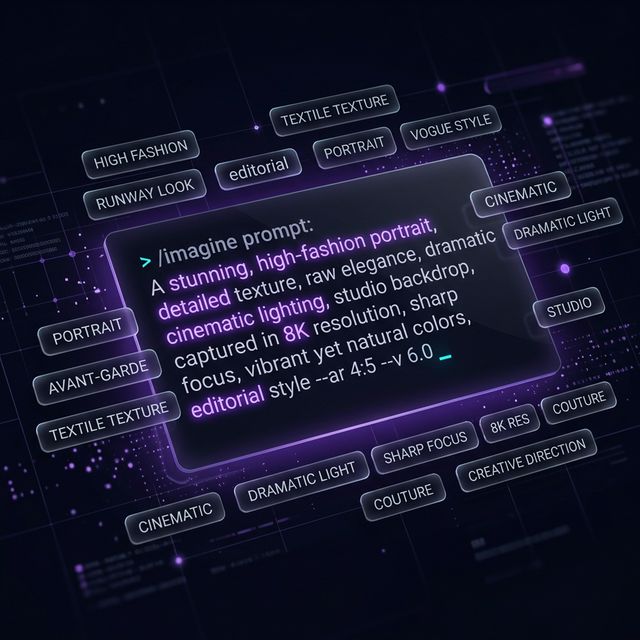
Why Prompts Matter More Than You Think
Here's the thing most people miss: the gap between a flat, forgettable AI image and one that looks like it belongs on a magazine cover usually comes down to about 20 or 30 words. The prompt does the heavy lifting. So let's pull one apart and see what's actually going on inside a good one.
The 6-Part Prompt Formula
Every professional prompt follows this structure:
- Subject: Who or what is in the image (model, product, scene)
- Clothing & Styling: Fabric, color, texture, fit, accessories
- Pose & Expression: Body language, facial expression, movement
- Lighting: Golden hour, studio softbox, cinematic, dramatic shadows
- Environment: Background, setting, props, atmosphere
- Camera & Quality: Lens focal length, aperture, 8K, photorealistic
Example: Basic vs. Professional Prompt
Weak prompt: "A woman wearing a red dress."
Much better: "Elegant Asian woman in a flowing crimson silk evening gown, standing in a marble-floored luxury hotel lobby, soft golden chandelier lighting, gentle smile, one hand on hip, 85mm portrait lens, f/2.8, shallow depth of field, 8K photorealistic, Vogue editorial style."
Power Words That Transform Results
Add these modifiers to instantly improve quality:
- Quality: photorealistic, 8K, ultra-detailed, masterpiece, award-winning
- Lighting: golden hour, studio softbox, rim lighting, cinematic, natural window light
- Style: editorial, Vogue cover, commercial, lifestyle, high fashion
- Camera: 85mm portrait, 35mm wide angle, f/1.4 bokeh, shallow depth of field
Common Mistakes to Avoid
- Too vague: "nice photo of model" → Add specific details about clothing, pose, and lighting
- Contradicting terms: "dark moody lighting" + "bright sunny day" → Pick one mood
- Ignoring composition: Always specify camera angle and framing
- Skipping quality tags: Always end with resolution and style descriptors
Pro Tip: Use the Auto-Enhance Feature
Not sure how to expand your prompt? Use our built-in Auto-Enhance button — it takes your basic idea and transforms it into a 200+ word professional prompt automatically using AI. It's included in all plans!